# 7 tips for Engineering Managers who also have to write code now
Andrew Murphy·2024-09-28·12 min read·Originally on Tech Leaders Launchpad
Heads up, I swear sometimes in my writing. Need to share this somewhere that dislikes swearing?
Introduction
In recent months, a worrying trend has been picking up across the engineering industry, as described by this article.
Companies are increasingly choosing to compress the Engineering Manager role into a primarily technical function, focused more on writing code than building and supporting their team.
This decision, often driven by short-term financial thinking, fails to appreciate the broader value that Engineering Managers bring to an organisation. They are not mere technical resources but the glue of the team, the people who grow talent and connect technical goals with business objectives.
To be clear, I don't endorse this approach. Leading takes a lot of time: putting out fires, preparing and running meetings, creating and managing roadmaps, overseeing recruitment and onboarding, supporting your peers, handling conflict, and communicating with other disciplines and stakeholders.
However, some of my readers are finding themselves in a situation now where they have to do it all: lead and support their team while also fulfilling short-term technical objectives.
I hope the practical tips in this post will help you handle this challenging situation if you find yourself unexpectedly back "on the tools."
Prioritise your self care
It's taxing to have to lead and code at the same time. You can spend all day working hard, doing your best, all whilst feeling like you're just trying to stay afloat.
Taking care of yourself is not a sign of weakness or indulgence; your own well-being and internal narrative are essential to yourself, and your team. See all of this as "putting your own mask on first" so you can help and support your team.
Here are some tips:
Set realistic expectations for yourself
Acknowledge that you're in a tough phase of your career. Set clear, achievable tasks and have a think about the number of tasks that you can realistically complete.
Even having a list of 5 things to do every day may seem unrealistic when you need a buffer to deal with things that need your attention all of a sudden.
Recognise that perfection is not the goal and also don't forget to celebrate progress, no matter how small it is. It can be easy to get caught up in the day-to-day tasks and forget that we are achieving small successes every day. Setting time aside at the end of each day, week, or sprint to reflect on your, and your team's, successes can help with this.
Seek Support
Don't tackle all the problems you have alone. Reach out to peers, mentors, or professional networks, where you might find other tech folks who are in a similar position as you. Perhaps reach out and see if you could connect and have a 1-1 chat with them.
Communities such as CTO School Australia and Rands Leadership Slack have regular online discussions, in-person and remote events, and even group coaching sessions that can provide guidance and help, a different perspective, and encouragement.
Focus on your health, physical and mental
Your body is a biological machine and if you don't keep it running smoothly then your brain won't function at peak performance. Investing in regular exercise, proper nutrition, frequent breaks, and adequate sleep can make a huge difference in how you tackle your challenges. These are not "lifestyle choices" but essential factors that influence your performance and decision-making.
Take your lunch break, eat it away on your own if you need to just have some time to yourself. Go for a break and get away from your computer. It's funny how many times I've gone for a walk with a problem and then immediately thought of a solution when I got back to my desk.
Additionally, consider mindfulness practices, hobbies, or activities that relax and recharge you. Manage stress through techniques like meditation or deep breathing exercises. If you're cycling down into stressful thoughts then you can't keep a clear mind to handle them.
Lastly, establish clear boundaries between work and personal life. Spend quality time with family and friends, and allow yourself breaks to recharge. Try to not think about work once you've finished for the day. Don't let all of those questions and challenges creep into your thoughts.
These tips might seem like indulgences, but they are not. If you don't focus on your own physical and mental health you aren't going to be in the right place to help your team.
Burning yourself out helps no one.
Focus your time on the most impactful work
As you take on a more hands-on technical role, the challenge isn't just adapting to new responsibilities. It's also figuring out which parts of leadership you absolutely must hold onto and which ones you can adjust or hand off.
Here are some things to not drop, and some things you can consider delegating.
Things you SHOULD NOT drop:
Communication and Collaboration
Breakdown in communication causes inefficiencies that will eat up your time and your team's time. Continue to keep communication flowing within your team and with other stakeholders (teams, departments, disciplines).
If you have regular 1-1s, perhaps you could reduce the frequency so you're still connecting with your team. This also helps ensure you are not constantly moving the 1-1s if your workload gets too much; skipped 1-1s are a sign to your team that you are prioritising things other than them!
Keep an eye open for places where communication might be lacking and break from your tech work to make sure it happens. Ensure that collaboration is encouraged and that team members feel supported when they are talking to other teams.
Team Development and Mentoring
Development and mentoring give you an outsized return on the time you put in. If you do something for somebody then it only gets done once; teach someone else to do it and they can do it every time afterwards.
The first time you teach them, it will take longer than if you had done the task yourself, but this is an investment in your time. In the future, it will take less and less time and eventually, they can teach others in your place.
Keep your role in growing and developing team members, providing regular feedback, and supporting their progress.
Vision and Strategy Alignment
Building the thing "in the right way" (technical architecture and skill) always needs to come second to building "the right thing" (vision, strategy and alignment).
Continuing to ensure that all technical efforts line up with the team's overall vision and goals is how you build "the right thing."
Any time you spend making sure you're pointing your, and your team's, efforts in the right direction is essential work!
Things a Leader Might Consider Adjusting or Delegating:
Direct Involvement in All Technical Tasks
If you are using your technical expertise in the work you do, make sure it is in the most impactful place. If you can, focus on your existing strengths rather than trying to reskill or retrain and, where it's not your strength, delegate to others.
Additionally, being too deep in the technical details can actually hold your team back by not letting them take ownership and responsibility. By giving team members real autonomy over specific tasks and providing guidance when they need it, you build a team that can handle more on their own.
And if you're buried in every technical detail, you'll lose sight of where the team is heading and what the organisation actually needs. Keep a balance: stay involved where your input matters, but don't lose the bigger picture.
Non-Essential Meetings
Reduce or delegate attendance at meetings that don't require your direct input, focusing only on those essential for key decisions. These may include routine status updates, brainstorming sessions for upcoming projects, or meetings where your presence is expected out of habit rather than necessity.
Do you really need to attend that meeting with accounting about the new payroll process? Or, can you watch the playback at 2x speed? Can you ask a senior team member to attend that meeting with Product Management about the new feature they want?
Handing off attendance at these meetings to capable team members can free up your time to focus on areas where your expertise is most needed.
This doesn't mean completely disconnecting from these discussions; instead, it's about recognising which meetings require your direct involvement and which can be handled by others. Brief summaries or reports from those who attend in your place can keep you informed without needing you in the room.
This approach requires trust in your team and clear communication about what counts as a non-essential meeting. By building a team where members feel comfortable representing leadership in these settings, you not only free up your time but also give others the chance to grow in responsibility and confidence.
Recruitment and Onboarding
Recruitment and onboarding are essential parts of building and maintaining a strong team. However, as an Engineering Manager taking on additional technical responsibilities, you may find it practical to delegate or collaborate with others on these tasks.
Hiring the right talent requires time and attention to detail. While your insights and final decisions matter, the early stages (screening CVs, conducting preliminary interviews, and coordinating with recruitment agencies) can be delegated to HR/P&C or senior team members. Working with HR/P&C to make sure they understand the technical requirements and cultural fit lets them handle the early stages of recruitment well. This is an investment in your time that will take longer in the beginning than if you just did it all yourself, but it will pay off in the long run.
Bringing new team members up to speed is another critical process that ensures they feel supported and can add value as quickly as possible. While it's essential for a leader to set the tone and expectations, the detailed orientation process can be shared with senior team members. They can handle the introduction to the codebase, product features, ways of working, tools, and processes. Your involvement can then focus on connecting the new person with the team's vision, goals, and culture, making sure there's a personal connection without having to oversee every aspect of the onboarding process.
Make the most of your “Leadership time” by focusing on your personal productivity
First, let's acknowledge that the idea of completing everything on your to-do list is a myth.
Sorry!
You must adapt to three realities:
- Self-Scheduling: Unlike in your past as an IC, now you must schedule the work yourself. The only person responsible for your own time and productivity is you!
- Reactive Work: Much of your leadership work can be reactive, requiring immediate attention.
- Proactive Work: Within all of this, you need to find time for strategic and continuous improvement work, which is the truly valuable and impactful leadership work.
These factors make it difficult to have a clear and easy-to-follow to-do list. It's essential to take ownership of your time and productivity, focusing on what matters most.
Structure your week into Technical & Leadership Time
Structure your day or week to allocate specific blocks for "Technical Time" and "Leadership Time." This clear division helps in maintaining a balance, ensuring that neither role overshadows the other.
Additionally, when you consider how to use your leadership time, use a framework for prioritisation and delegation, such as the Eisenhower Matrix.
The Eisenhower Matrix, named after President Dwight D. Eisenhower, is a time management tool. This matrix has two axes (importance and urgency) and it helps you tell the difference between what is urgent and what is truly important.
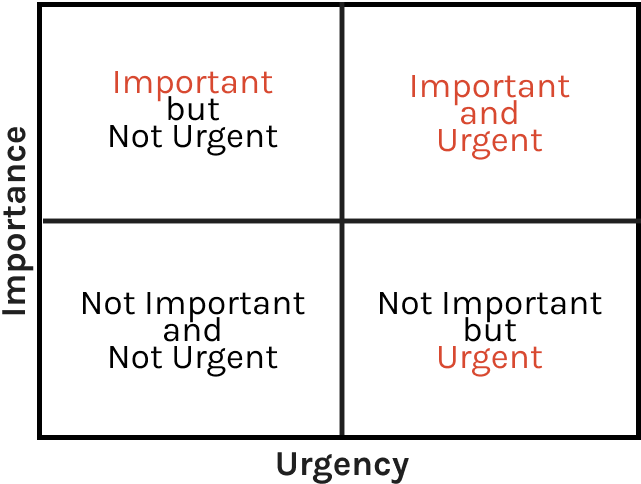
Urgent: Tasks that must be done immediately to capture their value, but we are making no judgement on what that value is. They simply have time pressure.
Important: Tasks that have high value and contribute to long-term objectives and goals. They have real impact.
Important and Urgent These tasks have high time pressure and high impact. These are tasks that you need to complete yourself due to their immediate necessity and significance. Due to their urgent nature, they typically need to be handled straight away and cannot wait for "Leadership Time."
Important but Not Urgent These tasks have long-term implications and high impact, like planning the next sprint, building relationships with your team members and peers, researching new practices, etc. These should be the focus of your "Leadership time." You may choose to delegate these, but regular check-ins and reviews are needed to make sure they get done.
Urgent but Not Important Tasks that make you feel busy, but could be done by someone else. Things like assisting a team member with a task they could complete themselves, administrative tasks, attending less-critical meetings, etc. These should be delegated whenever possible.
Not Important and Not Urgent These include activities like aimless scrolling on social media, unrelated work seminars, etc. They can be cut from your schedule.
Remember that time management is as much about what you don't do as it is about what you do. Delegation isn't just about passing tasks because you're overloaded. It's a deliberate choice that encourages team members to take ownership and feel accountable for the team's outcomes. It also gives team members the chance to grow and develop their skills.
Conclusion
If you're in this unenviable situation, remember that the core of what leadership is remains, and even in the face of change, it's your ability to adapt that will define your continued success.
Your success depends on more than just your technical skills. Balancing your leadership responsibilities, keeping your eye on the bigger picture, looking after your team, and taking care of your own well-being all matter.
This transition won't be easy, but the guidance in this article should give you a solid starting point. Lean into the challenge, and you'll not only get the technical work done but also keep your team moving forward together.